
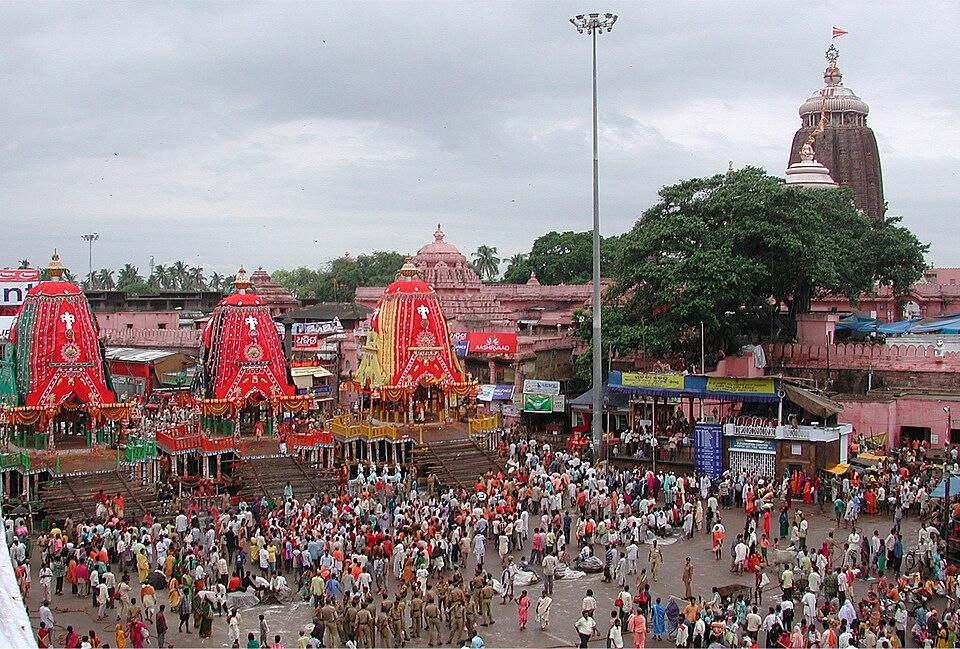
Rath Yatra (ରଥଯାତ୍ରା, Ratha Jatra) is the chariot festival of Puri, Odisha, held every year in the bright fortnight of Ashadha (June–July). Jagannath, his elder brother Balabhadra and sister Subhadra — with the discus Sudarshana — leave the Jagannath Temple on three huge wooden chariots and are pulled by devotees along the Bada Danda (the Grand Road) to the Gundicha Temple, about 3 km away. They stay there for seven days and return in the Bahuda Jatra. Wikipedia describes it as the oldest and largest Hindu chariot festival held every year.
A festival at least eight centuries old
The date of the first Rath Yatra is not known. It is described in the Brahma, Padma and Skanda Puranas and the Kapila Samhita, and the festival has been celebrated for more than 800 years. European travellers wrote about it from the 13th century onward, most vividly in the 17th. The English word juggernaut comes from "Jagannath", via those travellers' accounts of the giant chariots.
The three chariots
The chariots are built new every year and stand on the Bada Danda in front of the temple's eastern gate, the Singhadwara. Each carries nine painted wooden parsva devatas (side deities), a charioteer and four wooden horses.
| Nandighosa | Taladhwaja | Darpadalana | |
|---|---|---|---|
| Deity | Jagannath | Balabhadra | Subhadra |
| Wheels | 16 | 14 | 12 |
| Height (Wikipedia) | 44′ 2″ | 43′ 3″ | 42′ 3″ |
| Wooden pieces | 832 | 763 | 593 |
| Canopy colours | Red and yellow | Red and bluish green | Red and black |
| Charioteer | Daruka | Matali | Arjuna |
| Horses | Four white | Four black | Four red |
| Guardian | Garuda | Vasudeva | Jayadurga |
| Rope | Sankhachuda Nagini | Basuki Naga | Swarnachuda Nagini |
| Flag | Trailokyamohini | Unnani | Nadambika |
Published heights differ slightly between sources (Odisha Tourism says the chariots "rise nearly 45 feet"); all agree that Nandighosa is the tallest and Darpadalana the smallest.
How the chariots are built
Work begins on Akshaya Tritiya, the third day of the bright half of Vaisakha, with a fire ritual in front of the Puri king's palace — about two months before the festival. The wood comes from specified trees such as phassi and dhausa; logs from the former princely state of Dasapalla were traditionally floated down the Mahanadi as rafts and brought to Puri. Hereditary families of carpenters, painters and other craftsmen build the chariots by traditional measurements handed down within their families.
The festival calendar
Rath Yatra is the centre of a ritual season of about three months. The 2026 dates below are from Odisha Tourism.
| Ritual | What happens | 2026 |
|---|---|---|
| Chandan Jatra | 42 days of sandalwood rituals; for the first 21, festival images are rowed on the Narendra tank | from 19 April |
| Akshaya Tritiya | Chariot building begins | 20 April |
| Snana Purnima | The deities are bathed with 108 pots of water on the full moon of Jyeshtha | 29 June |
| Anasara | The deities "fall ill" and are hidden for about two weeks; devotees see only three painted Anasara pattis | after the bath |
| Rath Yatra | Pahandi procession to the chariots, Chhera Pahanra, and the pulling to Gundicha | 16 July |
| Hera Panchami | Lakshmi, left behind, visits Gundicha in anger — five days after the Rath Yatra | 5th day |
| Sandhya Darshan | Evening darshan at Gundicha before the return | 23 July |
| Bahuda Jatra | The return journey, with a stop at the Mausi Maa temple | 24 July |
| Suna Besha | The deities are dressed in gold on their chariots | 25 July |
| Adhara Pana | A sweet drink is offered on the chariots | 26 July |
| Niladri Bije | The deities re-enter the temple | 27 July |
Pahandi and Chhera Pahanra
On the day of the festival the deities are carried out of the temple in Pahandi, a swaying procession to the beat of gongs, cymbals and conches. The Gajapati Maharaja of Puri then performs Chhera Pahanra, sweeping the chariot platforms with a golden broom — a sign, Odisha Tourism says, of equality before the divine. Only then are the chariots pulled.
Anasara and the daitapatis
During the two weeks of Anasara the deities are given only roots, leaves, berries and fruit. They are served through this period and the whole festival by the daitapatis (daitas), who by tradition descend from the tribal chief Biswabasu's daughter Lalita and the Brahmin priest Vidyapati — a reminder of the tribal roots of the Jagannath cult.
Hera Panchami
On the fifth day, Lakshmi — left behind in the temple — is carried to Gundicha in a palanquin as Subarna Mahalaxmi to demand that Jagannath come home. According to the Madala Panji, King Kapilendra Deva replaced an earlier recitation with this procession of a golden Lakshmi image.
The return: Mausi Maa, Suna Besha and Niladri Bije
On the way back the chariots stop near the Mausi Maa ("aunt's") temple, where the deities are offered poda pitha, a baked rice cake said to be their favourite. The day after Bahuda comes Suna Besha: the deities are dressed in gold ornaments — over 200 kg, according to Odisha Tourism — and worshipped on the chariots; tradition credits the custom to Kapilendra Deva in 1460. Adhara Pana, a sweet drink in tall clay pots, follows, and on Niladri Bije the deities re-enter the temple. Tradition says Jagannath wins back the sulking Lakshmi with rasagola.
Significance
- Tradition says Jagannath is visiting his aunt's home, the Gundicha Temple.
- Many devotees believe that pulling the chariot ropes, or even touching them, brings spiritual merit.
- It is the one occasion when the deities come out among the people, and anyone may join in, whatever their caste or faith.
- The festival has inspired Rath Yatras worldwide, notably those organised by ISKCON in cities such as New York, London and San Francisco.
When is the next Rath Yatra?
Rath Yatra falls on the second day of the bright fortnight (Shukla Dwitiya) of Ashadha. Rath Yatra 2027 is expected on Monday 5 July 2027 — see Rath Yatra 2027: dates and schedule for the full ritual calendar, and the Puri travel guide for planning a visit.
Related: Snana Yatra • Nabakalebara • Mahaprasad • Jagannath Temple


