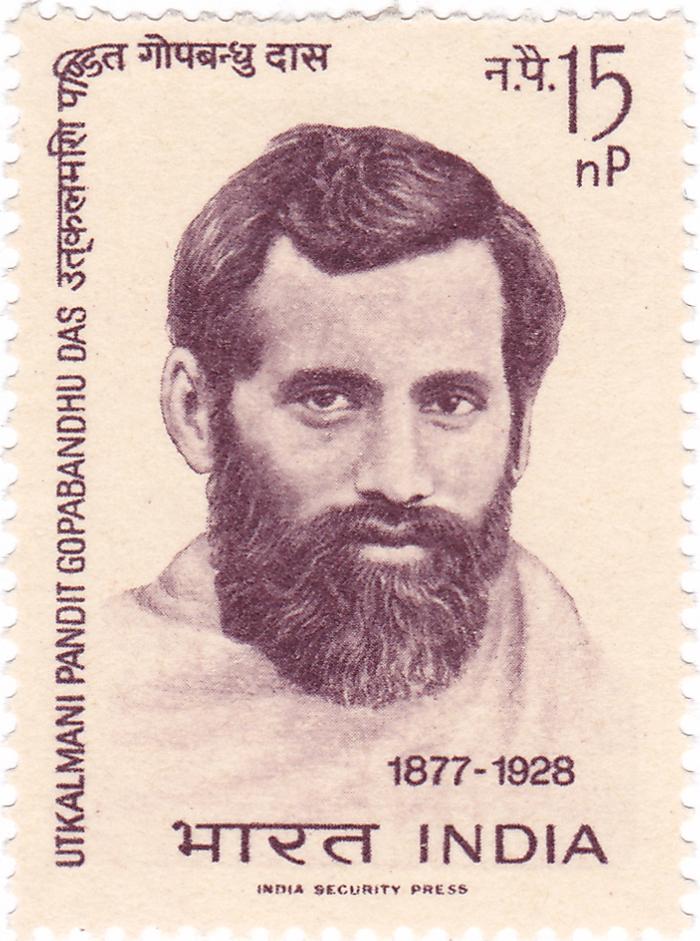
Gopabandhu Das (ଗୋପବନ୍ଧୁ ଦାସ, 1877–1928) is one of the most revered figures in Odia history. Called "Utkalmani" (ଉତ୍କଳମଣି — the Jewel of Utkal/Odisha), he was a poet, journalist, freedom fighter, educator, and social reformer who dedicated his life to the service of Odisha's people.
Quick Facts
| Aspect | Details |
|---|---|
| Birth | October 9, 1877, Suando village, Puri |
| Death | June 17, 1928 |
| Title | Utkalmani (Jewel of Utkal) |
| Professions | Lawyer, poet, journalist, politician |
| Founded | The Samaja newspaper (1919) |
| Movement | Separate Odisha province, Indian independence |
Early Life
Gopabandhu Das was born in Suando, a small village near Puri:
- Father: Daitari Das, a mukhtiar (legal agent); mother: Swarnamayee Devi
- Showed extraordinary intelligence from childhood
- Studied at Puri Zilla School
- Graduated from Ravenshaw College, Cuttack
- Completed MA and law degrees from Calcutta University
His Many Roles
The Lawyer Who Quit Law
- Practiced law in Puri and Cuttack, and in 1909 became State Pleader for Mayurbhanj
- Gave up a promising legal career to serve the poor and devote himself to education and public work
The Educator
Founded Satyabadi Bana Vidyalaya (1909) — one of Odisha's most important schools:
| Feature | Details |
|---|---|
| Location | Satyabadi, near Puri |
| Philosophy | Learning in nature, character building |
| Medium | Odia language |
| Teachers | Gopabandhu and fellow reformers |
The school's teachers, remembered as the "Panchasakha" of Satyabadi, included:
- Nilakantha Das — Scholar and politician
- Godabarish Mishra — Writer and freedom fighter
- Krupasindhu Mishra — Historian
- Acharya Harihar Das — Educator and freedom fighter
The school closed in 1926.
The Journalist
Founded The Samaja (ସମାଜ) newspaper in 1919:
- Began as a weekly from the Satyabadi school campus and became a daily in 1927
- One of the oldest and most respected Odia newspapers
- Used as a platform for independence movement
- Published bold articles against British policies
- Still published today — over 100 years later
The Poet
Gopabandhu was a gifted poet whose verses moved millions:
His most famous poem — Bandira Atmakatha (Prisoner's Autobiography): Written while jailed by the British in Hazaribagh, it captured the suffering and spirit of freedom fighters.
Key poetic works:
- Bandira Atmakatha — Prisoner's story (masterpiece)
- Abakasa Chinta — Reflections
- Dharmapada — Poem on the legend of the boy Dharmapada of Konark
- Kara Kabita — Poems written in prison
- Various patriotic poems that became anthems
The Freedom Fighter
- Active participant in Non-Cooperation Movement (1920)
- Jailed by the British; sentenced in 1922 to two years and released from Hazaribagh jail in 1924
- Member of the Bihar and Orissa Legislative Council from 1917
- First president of the Utkal Pradesh Congress Committee (1920)
- Fought tirelessly for a separate Odisha province
- Worked closely with Mahatma Gandhi
The 1866 Famine Legacy
Though Gopabandhu was born after the devastating Na'anka Famine of 1866 (which killed an estimated one million people in Odisha), its memory shaped his activism:
- He dedicated his life to ensuring famine never repeated
- Built awareness about rural poverty
- Advocated for food security and irrigation
- His relief work during the 1927 floods is remembered as a heavy strain on his health
The 1927 Floods — His Ultimate Sacrifice
In 1927, devastating floods hit Odisha:
- Gopabandhu personally led relief operations
- Toured flood-hit areas to organise food and aid
- In 1928 he became All-India Vice-President of Lala Lajpat Rai's Servants of the People Society (Lok Sevak Mandal)
- Died on June 17, 1928, aged 50 — less than a year after the floods
His Vision for Odisha
Gopabandhu dreamed of an Odisha that was:
- United — All Odia-speaking areas in one province
- Educated — Every child in school
- Self-sufficient — Free from poverty and famine
- Proud — Of its language, culture, and heritage
- Free — From British colonial rule
Legacy & Honors
Government
- His birth anniversary (October 9) and death anniversary (June 17) are observed across Odisha
- Many government schemes named after him
- Featured on Indian postal stamps
Institutions Named After Him
- Gopabandhu Ayurvedic College, Puri
- Gopabandhu Science College, Athagada
- Multiple schools, roads, and buildings across Odisha
Cultural Impact
- His poems are taught in every Odia school
- The Samaja newspaper continues his journalistic legacy
- Satyabadi school is a pilgrimage for education lovers
- His selfless model of leadership inspires politicians
Timeline
| Year | Event |
|---|---|
| 1877 | Born in Suando, Puri |
| 1900s | Completed MA and law degrees at Calcutta |
| 1909 | Founded Satyabadi Bana Vidyalaya |
| 1917 | Elected to Bihar-Odisha Legislative Council |
| 1919 | Founded The Samaja newspaper |
| 1920 | Joined Non-Cooperation Movement |
| 1922–1924 | Imprisoned in Hazaribagh jail |
| 1927 | Led flood relief — destroyed his health |
| 1928 | Died on June 17 |
Places to Visit
| Place | Significance |
|---|---|
| Suando | Birthplace (near Puri) |
| Satyabadi | His famous school |
| The Samaja Office, Cuttack | Newspaper he founded |
| Gopabandhu Memorial, Puri | Statue and memorial |
Related: Madhusudan Das • Fakir Mohan Senapati • Notable People