Skip to content

Koraput district

କୋରାପୁଟ ଜିଲ୍ଲା

Koraput is a tribal-majority hill district of southern Odisha, home to Deomali (Odisha's highest peak), Kotpad weaving and Kalajeera rice.

Headquarters
Koraput
Population (2011)
1,379,647
Area
8,807 sq km
Villages
2,127
Literacy (2011)
49.2%
Towns (2011)
7

Koraput (କୋରାପୁଟ) is a hill district in southern Odisha, set on the Eastern Ghats plateau along the borders with Andhra Pradesh and Chhattisgarh. Koraput is best known for Deomali, the highest peak in Odisha, for waterfalls and reservoirs such as Duduma and Kolab, and for being, in the words of its district administration, the heartland of Odisha's tribal communities.

The district headquarters is the hill town of Koraput, which sits at roughly 870 to 890 m above sea level. The largest town is Jeypore, the former seat of the Jeypore rulers. The district has two sub-divisions, Koraput and Jeypore, and 14 community development blocks.

Koraput district was created on 1 April 1936, when the province of Orissa was formed and the area was transferred from the Madras Presidency. In October 1992 it was divided into four districts: Koraput, Rayagada, Nabarangpur and Malkangiri. The district administration gives the date as 1 October 1992, while several other official sources give 2 October 1992.

Koraput covers 8,807 sq km, which Wikipedia lists as the third-largest district area in Odisha. The 2011 Census counted 1,379,647 people. About half the population (50.6%) belongs to Scheduled Tribes, and literacy stood at 49.21% in 2011.

People of Koraput district

Census 2011 counted 13,79,647 people in 3,37,677 households in Koraput district. 16.4% lived in towns, and the literacy rate (age 7 and over) was 49.2%. The census recognised 7 towns in the district.

Population
13,79,647
6,78,809 male · 7,00,838 female
Households
3,37,677
about 4.1 people each
Literacy (age 7+)
49.2%
men 60.3% · women 38.6%
Females per 1,000 males
1,032
Girls per 1,000 boys (0–6)
979
People per km²
157
  • Rural11,53,478 (83.6%)
  • Urban2,26,169 (16.4%)
Scheduled Castes
1,96,540 (14.2%)
Scheduled Tribes
6,97,583 (50.6%)

What the 6,93,406 workers did

  • Cultivators1,60,768 (23.2%)
  • Agricultural labourers89,164 (12.9%)
  • Household industry7,786 (1.1%)
  • Other work1,38,742 (20.0%)
  • Marginal workers2,96,946 (42.8%)

Marginal workers worked less than six months of the year.

Source: Census of India 2011, Primary Census Abstract (district, sub-district and town level). Figures are from 2011, the most recent census with published district, town and village figures.

Facilities in the villages of Koraput

How many of the 1,941 inhabited villages of this district had each facility within the village itself, from the Census 2011 Village Directory. Together the 2,041 villages cover 6,033 km², 43% of it sown with crops and 10% forest.

Education

  • Primary school1,587 of 1,941
  • Middle school557 of 1,941
  • Secondary school172 of 1,941
  • Senior secondary school26 of 1,941
  • Degree college36 of 1,941

Health

  • Primary health centre5 of 1,941
  • Health sub-centre252 of 1,941
  • Anganwadi centre1,495 of 1,941

Water & power

  • Treated tap water0 of 1,941
  • Hand pump1,840 of 1,941
  • Electricity for homes1,052 of 1,941

Roads & transport

  • All-weather road1,008 of 1,941
  • Public bus138 of 1,941
  • Mobile phone coverage1,489 of 1,941

Services

  • Post office or sub post office239 of 1,941
  • Commercial bank2 of 1,941
  • Ration (PDS) shop367 of 1,941
  • Weekly haat81 of 1,941
Primary schools
1,897
Middle schools
623
Secondary schools
233
Degree colleges
38
Primary health centres
10
Health sub-centres
252

Main crops named by villages: Paddy (1,730), Ragi (1,324), Maize (361), Oil Seeds (162), Nizer (137), Arhar (113), Sugarcane (105), Vegetables (92). Handicrafts: Terracota (2).

Source: Census of India 2011, District Census Handbook: Village and Town Directory (Odisha). The facilities were recorded for the 2011 census (reference year 2009 for most items); many places have changed since. Facilities in towns are not included.

Towns of Koraput

4 statutory towns (municipal corporation, municipality, notified area council or industrial township) and 3 census towns — places the census counted as urban but which are governed by gram panchayats.

TownTypePopulationLiteracyWards
JeypurMunicipality84,83082.4%28
Sunabeda (NAC).50,39484.0%23
KoraputNotified Area Council47,46882.0%15
KotpadNotified Area Council16,32676.2%13
BorigumaCensus town9,78572.8%–
DamanjodiCensus town8,86293.2%–
KurumuliCensus town8,50469.9%–

Population of the town itself; for towns with outgrowths, the town page also gives the figure including them. Ward counts are the census wards of 2011.

Census sub-districts: town and country

Sub-districtPopulationRuralUrbanLiteracy
Kotpad1,20,9291,04,60316,32649.9%
Boriguma98,34188,5569,78547.6%
Bhairabsingipur70,42070,420043.7%
Dasamantapur50,73650,736041.7%
Lakshmipur40,23240,232042.1%
Narayanpatana43,57543,575037.9%
Bandhugaon58,97458,974032.9%
Kakiriguma25,32925,329043.4%
Koraput68,19368,193046.1%
Koraput Town54,8327,36447,46877.7%
Jeypore1,81,90697,07684,83066.3%
Kundura57,03857,038043.5%
Boipariguda1,25,3371,25,337037.9%
Machh kund41,13241,132046.6%
Padua54,56154,561040.0%
Nandapur72,57972,579040.5%
Similiguda22,24722,247046.7%
Sunabeda65,66415,27050,39478.6%
Damonjodi29,43112,06517,36668.5%
Pottangi88,12888,128034.7%
Kotiya10,06310,063022.0%

Odisha's census sub-districts are police-station areas, not revenue tahasils.

History

Early kingdoms. The district administration's history notes that the Nala kings ruled this region in the early centuries CE, with their capital at Pushkari. Historians differ on where Pushkari lay: older studies placed it at Podagada near Umerkote (now in Nabarangpur district), while more recent work identifies it with a site in the Bastar region.

Nandapur and Jeypore. In medieval times Nandapur became the capital of the Silavamsi kings. In the mid-15th century, according to the district administration, Vinayak Deo founded the line later known as the Jeypore Raj family and inherited the Silavamsi kingdom. In 1571 the kingdom became a feudatory of the Qutb Shahis of Golconda. In the mid-17th century the ruler Vir Vikram Deo moved the headquarters from Nandapur to Jeypore, which remained the seat of the family.

British period. Under British rule the Jeypore estate was part of the Madras Presidency. The British chose Koraput town as an administrative centre in 1870 because of its healthier climate. When Orissa became a separate province, Koraput district was formed on 1 April 1936, with R. C. S. Bell as its first District Magistrate and Collector.

Freedom movement. The Quit India Movement of 1942 was strongly felt in the Koraput hills. Laxman Nayak, born at Tentuligumma in 1899, led a procession of tribal protesters to the Mathili police station (now in Malkangiri district) in August 1942. Police opened fire, and Laxman Nayak was later tried and sentenced to death; he was hanged at Berhampur Jail on 29 March 1943. In the same month of August 1942, police fired on a procession at Papadahandi, now in Nabarangpur district, killing 19 people. The district administration also notes the role of Maharaja Vikram Deo of Jeypore in the movement for a united Odisha.

After independence. Koraput is a Fifth Schedule (Scheduled Area) district, and in 2006 it was listed among India's 250 most backward districts for the Backward Regions Grant Fund. It is part of the KBK (Kalahandi–Balangir–Koraput) region targeted by special development programmes.

Places to visit

For a traveller's guide with seasons and practical tips, see our Koraput travel guide and the Koraput tribal heritage itinerary.

Deomali

Deomali is Odisha's highest peak, at about 1,672 m. The summit area has open grassland and wide views over the Eastern Ghats, and is visited for trekking, sunrise and photography. Odisha Tourism lists it as open year-round; sources give different road distances from Koraput town, so check locally.

Duduma waterfall

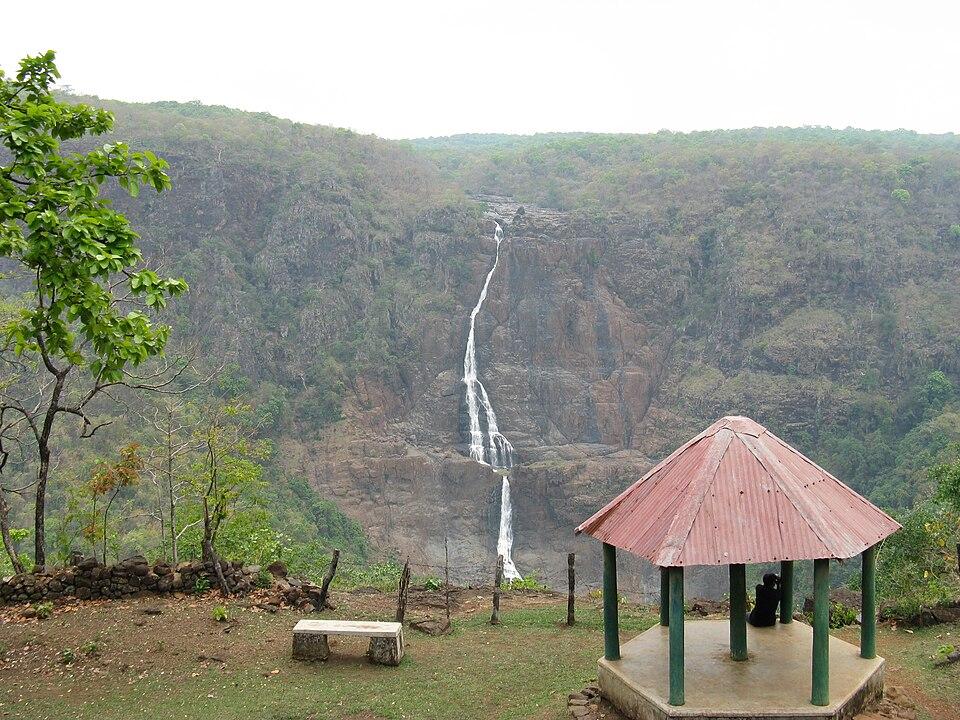
Duduma is formed by the Machkund river on the Odisha–Andhra Pradesh border, about 92 km from Koraput town according to Wikipedia. Sources differ on its height: figures of about 157 m and 175 m are both quoted. The Machkund hydroelectric project, a joint venture of Odisha and Andhra Pradesh, lies nearby.

Gupteswar

Gupteswar is a limestone cave shrine to Shiva near the Kolab river, roughly 55 km from Jeypore. Visitors climb a flight of steps to the cave, which holds a natural linga. According to tradition, Rama found the linga while passing through the Dandakaranya forest, and the nearby hill is called Ramagiri. Maha Shivaratri draws very large crowds from Odisha, Andhra Pradesh and Chhattisgarh.

Sabara Srikhetra

Sabara Srikhetra is the Jagannath temple of Koraput town. Incredible India describes it as the southern abode of Lord Jagannath, built in 1972, and notes that it holds an annual chariot festival with tribal participation, an echo of the Rath Yatra at Puri.

Kolab reservoir and Sunabeda

The Kolab reservoir, close to Koraput town, is a popular spot for sunset views and has a botanical garden nearby. Sunabeda, about 20 km from Koraput, is a planned township built around the aero-engine factory of Hindustan Aeronautics Limited (HAL) and is also home to the Central University of Odisha.

Nandapur and Subai

Nandapur, the old capital of the Silavamsi and early Jeypore rulers, preserves the Batrisa Simhasana ("throne of 32 steps") among other relics, according to the district administration. Subai, about 34 km from Koraput, has the remains of a Jain temple complex with rare images of Tirthankaras; the Government of Odisha describes it as a Jain monastery of the medieval period, though some researchers date it earlier.

Jeypore

Jeypore, the district's largest town, was established as the seat of the rulers in the mid-17th century. It has the old fort and palace area, Vikram Dev University, and the region's airport.

How to reach

ModeDetails
AirJeypore Airport, about 3 km from Jeypore, has had IndiaOne Air flights to Bhubaneswar and Visakhapatnam since 31 October 2022. Visakhapatnam International Airport is roughly 170 km from Koraput, according to Odisha Tourism
RailKoraput Junction is on the Kottavalasa–Kirandul line; Jeypore, Kotpad Road, Damanjodi and Laxmipur Road are other stations. The daily Hirakhand Express links Bhubaneswar with Koraput and Jeypore via Brahmapur and Rayagada. Since 1 June 2026 these lines fall under the new Rayagada division of East Coast Railway
RoadNH 26 runs through Pottangi, Koraput, Jeypore and Nabarangpur; NH 63 branches west at Borigumma towards Jagdalpur; NH 326 links Koraput with Rayagada via Laxmipur. Odisha Tourism gives the distance from Bhubaneswar as approximately 500 km

Flight schedules change often, so check current timings before booking. For the wider picture, see how to reach Odisha and the best time to visit Odisha.

Temples (6)

  • Bairava Temple
  • Ganesha Temple
  • Jaina Temple
  • Neelkantheswar Temple · ନୀଳକଣ୍ଠେଶ୍ଵର ମନ୍ଦିର
  • Sarvesvara Temple
  • Shri Ram Temple, Dumuriput · ଶ୍ରୀରାମ ମନ୍ଦିର, ଡୁମୁରିପୁଟ

Photos and map links in the temple directory. Today's tithi, sunrise and Rahu Kala here.

Railway stations

23 stations and 0 halts inside the district, as mapped on OpenStreetMap; some on new lines may not yet have regular trains.

Culture and festivals

Koraput is home to many Adivasi communities. The largest are the Paraja, followed by the Kondh; the Bhottada, Gadaba and Bhumia are also prominent. In the 2011 Census, Odia was the first language of about 54% of the people, followed by Desia (the local variety of Odia used across communities, see Odia dialects), Kui, Paraja, Telugu, Kuvi and Gadaba.

Festivals. The annual Parab festival, highlighted by Incredible India, brings together tribal dance, music and crafts. The Rath Yatra at Sabara Srikhetra is the largest Jagannath festival of the region.

Crafts and GI products.

ProductWhat it isGI status
Kotpad Handloom FabricCotton cloth woven by Mirgan weavers of Kotpad and dyed with the root of the aal treeRegistered February 2005, Odisha's first GI
Koraput Kalajeera RiceSmall-grained aromatic rice with black husk, grown by tribal farmersRegistered January 2024

Read more on our pages about Kotpad handloom and GI tags of Odisha.

Literature. The Koraput hills are the setting of Paraja (1945) by Gopinath Mohanty, who spent much of his government service in undivided Koraput.

Food

The everyday food of rural Koraput is built on rice and finger millet, called mandia (ragi) in Odia. Mandia peja, a gruel of ragi and rice, is a staple of Adivasi households across Koraput and the neighbouring districts. Incredible India's food guide to Koraput lists other millet dishes such as mandia tampa (ragi porridge cooked with broken rice), mandia ruti (flatbread) and mandia sijha pitha (steamed dumplings wrapped in banana leaf), along with dishes cooked in bamboo shoot or wrapped in sal leaves.

The aromatic Kalajeera rice is the district's best-known rice, and Koraput also grows coffee (see Economy).

Geography and climate

Koraput lies in the south-west of Odisha. Within the state, it borders Rayagada, Nabarangpur and Malkangiri districts; to the south and east lies Andhra Pradesh, and to the west the Bastar region of Chhattisgarh. Much of the district is an upland of two broad plateaus, at average heights of roughly 3,000 feet and 2,000 feet, cut by valleys and forested ridges.

Rivers. The Indravati forms part of the boundary with Nabarangpur. The Kolab rises near the Andhra Pradesh border and is dammed to form the Kolab reservoir; further downstream the same river is known as the Sabari. The Machkund, known lower down as the Sileru, forms part of the Odisha–Andhra Pradesh boundary and plunges over Duduma waterfall.

Hills. Deomali is the highest point in Odisha at about 1,672 m (5,486 ft), according to Odisha Tourism. The Panchpatmali range near Damanjodi holds large bauxite deposits.

Climate. Koraput is cooler than coastal Odisha because of its height. The monsoon brings most of the rain between June and September, and winter nights on the plateau can be cold.

Climate indicatorValue (as given in Wikipedia's district article)
Average summer temperatureabout 38°C
Average winter temperatureabout 12°C
Average annual rainfallabout 1,522 mm
Best time to visitOctober to March (Odisha Tourism)

Economy

Agriculture. Most people depend on farming: paddy in the valleys, and millets, pulses and vegetables on the uplands. In 2012 the UN Food and Agriculture Organization recognised Koraput traditional agriculture as a Globally Important Agricultural Heritage System, for the rice diversity conserved by tribal farmers.

Coffee. Coffee was first planted experimentally at Bichalkota around 1930 under the Jeypore rulers, and the Coffee Board expanded it from 1958. The Better India reported in 2026 that about 3,000 hectares of shade-grown Arabica are cultivated by roughly 3,200 growers, marketed under the Koraput Coffee brand of the Tribal Development Co-operative Corporation of Odisha.

Industry and mining. Major units include:

  • HAL Sunabeda, which makes aero-engines, including the AL-31 engines for the Indian Air Force's Su-30MKI fleet.
  • NALCO at Damanjodi, an alumina refinery fed by the bauxite of the Panchpatmali hills.
  • The Kolab and Machkund hydroelectric projects.

The district also has deposits of limestone, china clay and other minerals.

Climate of Koraput

In Koraput district (at 18.81°N, 82.71°E), the hottest month is May (average highs of 33°C) and the coolest nights come in Jan (13°C). About 1520 mm of rain falls in a year, most of it in the monsoon; Jul is the wettest month.

JanFebMarAprMayJunJulAugSepOctNovDec
Average high (°C)252831333329252526262524
Average low (°C)131518212322212120191513
Rainfall (mm)961535712433773612551052614
Rainy days11257162323191021

Averages for 1995–2024 at that point (894 m above sea level), from the Open-Meteo historical weather API (ERA5 reanalysis by ECMWF/Copernicus, CC BY 4.0) — modelled values on a ~25 km grid, not station readings from the India Meteorological Department. A rainy day has 2.5 mm or more.

Notable people

  • Laxman Nayak (1899–1943): tribal freedom fighter from Tentuligumma, hanged at Berhampur Jail on 29 March 1943 after the Mathili protest of 1942.
  • Maharaja Vikram Deo of Jeypore: ruler of Jeypore who, according to the district administration, played an important role in the movement that created the province of Odisha.

Blocks, sub-districts, panchayats & villages

Choose a block, sub-district or town to see its details and its gram panchayats and villages. Open any village for its own page.

Counts below: Local Government Directory, December 2022 snapshot (LGD villages, which can differ from the district administration's revenue-village count).

Blocks
14
Sub-districts
21
GPs
240
LGD villages
2,127

Community development block

Bandhugaon

Gram panchayats
13
Villages
153
LGD block code
3466
District
Koraput
Open full block page

Villages (…)

All blocks in Koraput

BlockGPsVillagesVillage pop.LiteracyST share
Bandhugaon1315358,98132.9%79.8%
Boipariguda203171,12,13336.1%59.3%
Borigumma311461,41,51445.2%52.6%
Dasamantapur1617880,59842.2%57.3%
Jeypore221291,22,48449.3%47.7%
Koraput149961,10348.7%47.8%
Kotpad1710896,82344.8%62.5%
Kundura168371,06245.3%51.0%
Lamtaput1518558,27841.4%46.8%
Laxmipur1310966,26942.6%70.0%
Nandapur2323293,09141.3%51.6%
Narayan Patana914243,92037.8%84.5%
Pottangi1414269,40132.5%66.6%
Semiliguda1710377,71245.1%50.3%

GPs and villages: Local Government Directory (Dec 2022). Village population, literacy and Scheduled Tribe share: sum of the block's villages in Census of India 2011, Primary Census Abstract (village level).

All census sub-districts

Towns (urban local bodies)

Assembly constituencies in Koraput

Source: Local Government Directory (lgdirectory.gov.in), Government of India — data dump of December 2022 via github.com/planemad/india-local-government-directory. Sub-districts follow the Local Government Directory, which for Odisha uses the Census sub-districts (police-station areas) — these are not the same as revenue tahasils. Boundaries and names change over time; check the district administration for current status.

Frequently asked questions

What is Koraput district famous for?

Koraput is known for Deomali, the highest peak in Odisha, for Duduma waterfall and Gupteswar cave shrine, for its many Adivasi communities, and for two GI products: Kotpad handloom and Koraput Kalajeera rice.

When was Koraput district formed?

Koraput district was created on 1 April 1936, when the new province of Orissa was formed. In October 1992 the large undivided district was split into four: Koraput, Rayagada, Nabarangpur and Malkangiri.

What is the highest peak in Odisha?

Deomali in Koraput district is Odisha's highest peak, at about 1,672 m above sea level according to Odisha Tourism.

How do I reach Koraput?

Koraput has a railway station on the Kottavalasa–Kirandul line with a daily train from Bhubaneswar. Jeypore Airport, near Jeypore town, has had regional flights since October 2022, and Visakhapatnam International Airport is the nearest large airport.

Sources & references

  1. 1History | Koraput District — District Administration, Koraput, Government of Odisha
  2. 2Koraput district — Wikipedia
  3. 3Koraput District: Census 2011 data — Census2011.co.in (compiled from Census of India 2011)
  4. 4Deomali Hills — Odisha Tourism, Government of Odisha
  5. 5Koraput: where nature meets tribal heritage — Incredible India, Ministry of Tourism, Government of India
  6. 67 Tribal-linked Odisha Products Get GI Tag — The Indian Tribal
  7. 7This Coffee Grows Under Forest Canopies in Odisha. Here's How Koraput Built Its Own Brand — The Better India
  8. 8Laxman Nayak — Wikipedia

Last reviewed . How we check articles

Report an error